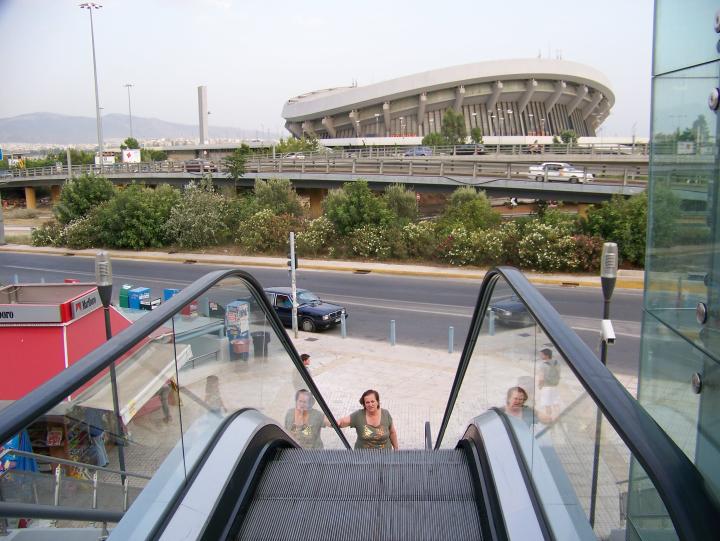
Olympic Stadium, part of the Athens Olympic Sports Complex (OAKA) in Athens, Greece (June 2007)
This was probably shot on 5 July 2007 whilst looking for the Olympic Arena where Iggy Pop was scheduled to perform that day. From afar, it looked like a magnificent building with a UFO-shaped roof. Fascinated with the architecture, took a few quick photos and found the location of the Iggy concert.
Iggy Pop and The Stooges performed at the Hellinikon Olympic Complex in Athens, Greece on July 5, 2007. This concert was part of the Gagarin Open Air Festival 2007. (Please see/search Iggy Pop photos on DonnaVision).
Meanwhile, sad to report that this remarkable structure is no longer as seen in these images. (Links to articles/websites provided below)
The Athens Olympic Stadium, which featured a striking roof designed by Santiago Calatrava for the 2004 Athens Olympics, faced significant maintenance issues and was forced to close in late 2023 due to safety concerns regarding the roof's structural integrity, with rust being a reported factor. Greek officials acknowledged that the stadium had not been properly maintained for two decades.
The closure led to the cancellation of planned events, including a Coldplay concert. As part of the necessary maintenance, approximately 5,000 polycarbonate panels were removed from the roof structure. The stadium subsequently reopened in May 2024 after these repairs were undertaken. Renovations of the Olympic complex are expected to be completed by 2026.
(As seen in this photo, including some interesting UFO reports in 2007): Olympic Stadium, part of the Athens Olympic Sports Complex (OAKA). Designed by Santiago Calatrava for the 2004 Summer Olympics, this roof features two giant arches spanning 304m and soaring to a maximum height of 72m. The roof's construction uses a network of steel pipes and blue glass, covering an area of nearly 25,000 square meters. While its design is striking and modern, describing it as "UFO-shaped" is subjective and likely an exaggeration.
In 2007, an incident in Athens involving a reported UFO sighting by pilots garnered media attention. However, this was an aerial phenomenon and not related to a physical structure. According to www.upi.com, the Greek aviation authority released a report detailing that three Olympic Airways pilots saw the object in the night sky and the Greek air force dispatched two F-16 fighter planes. The object was described by the Olympic pilots as resembling a star but larger, brighter and with a constantly changing shape. According to www.upi.com, Greek authorities later said the object spotted by the pilots was the planet Venus.
The roof of Athens' "OAKA" Olympic Stadium, renovated for the 2004 Olympic Games, was designed by renowned architect Santiago Calatrava. The stadium roof features a large polycarbonate installation using Palsun polycarbonate panels.
The renovation included a new roof structure and was part of a larger effort to modernize the stadium for the 2004 Summer Olympics. The polycarbonate panels were fitted into a pre-assembled glazing system designed with features like 0° slope, built-in drainage, and expansion gaps. The project used 24,000 square meters of PALSUN® Flat Solid Polycarbonate Sheet, specifically the Solar Olympic 12 mm type.
The stadium's renovation was completed in 2004, and the venue served as the centerpiece for the athletic events during the 2004 Summer Olympics.
The lavish and striking roof of the Athens Olympic Stadium, completed for the 2004 Summer Olympics, was designed by renowned Spanish architect Santiago Calatrava. The roof was praised for its aesthetic qualities and for turning the stadium into a significant architectural landmark in Athens.
Design and Features
The roof was designed as a lightweight structure, consisting of two half-shells that, when joined, enclosed the playing field.
It was composed of a network of steel pipes and blue polycarbonate panels that created a striking visual effect, while also providing shade and weather protection for athletes and spectators.
The use of polycarbonate, rather than Calatrava's initial thought of glass panels, was chosen for its lighter weight.
The roof's innovative design allowed it to rest on only four points where the arches intersected, without directly connecting to the pre-existing stadium structure.
The roof, along with other architectural elements such as the Wall of Nations sculpture and the Agora steel arcade, were part of Calatrava's masterplan for the entire Athens Olympic Sports Complex (OAKA).
The structure was designed to withstand winds up to 120 km/h.
The polycarbonate panels had a special coating that reflected 60% of the sunlight, enhancing comfort for attendees during the hot Greek summer.
Construction Challenges and Context
Despite initial criticisms and skepticism regarding the project, the roof was finished shortly before the opening ceremony of the Athens Olympics on July 30, 2004.
The complex installation process, involving the precise joining of the two arch halves and placing the roof panels, caused significant delays to the overall stadium preparations, including work on the track and equipment setup.
Further delays occurred during the design adjustment phase due to the contractor's verification showing the initial design was not structurally sound under certain conditions, leading to the need to stiffen the structure and increase the size of the main arches. This added about 30% to the weight of the arches and a proportional increase in cost, according to a report.
The construction faced a tight deadline, requiring the assembly of the roof near the stadium and then moving it into place using PLC-controlled hydraulic pumps and a pulling system.
In October 2023, the stadium was temporarily closed for urgent repairs after rust was discovered on the iconic arched roof structure.
https://www.mondoworldwide.com/na/en/spaziomondo/olympics/project-athens-olympic-stadium
https://www.theguardian.com/world/2023/oct/05/olympic-torture-greece-contemplates-dismantling-of-games-stadium-roof
https://www.panathenaicstadium.gr/en/home