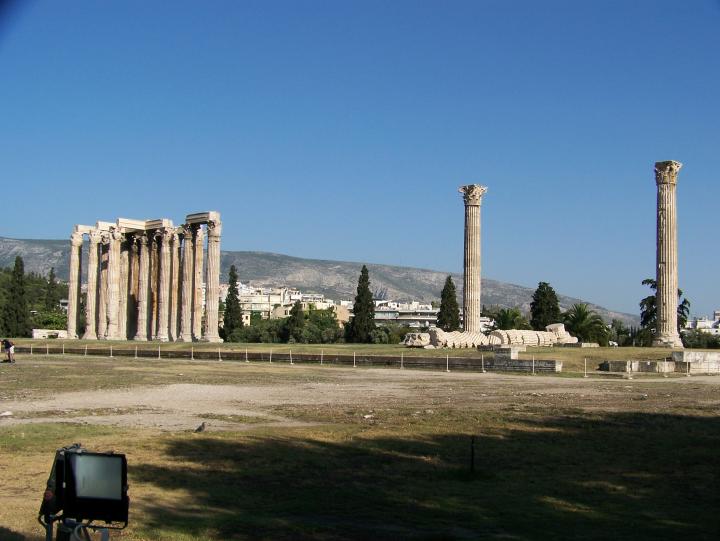
Temple of Olympian Zeus in Athens, Greece (June 2007)
The Temple of Olympian Zeus in Athens, one of the largest temples in the ancient world, was initially conceived around 515 BC but wasn't completed until the Roman era, specifically by Emperor Hadrian in 131/132 AD. The Hadrianic temple, built of Pentelic marble with Corinthian columns, featured a massive structure with two rows of twenty columns on the long sides and three rows of eight columns on the ends.
Here's a more detailed breakdown:
Early Beginnings:
The temple's construction began in the 6th century BC, but political instability and other factors led to numerous delays and periods of abandonment.
Roman Intervention:
Emperor Hadrian, during his reign in the 2nd century AD, revived the project and oversaw its completion.
Architectural Style:
The temple was designed in the Corinthian order, a style known for its elaborate columns with decorative capitals.
Materials:
It was constructed using Pentelic marble, a high-quality stone that was also used for the Parthenon.
Column Arrangement:
The temple had a total of 104 columns, with 20 on each of the long sides and 8 on each of the shorter ends.
Size and Significance:
The Temple of Olympian Zeus was one of the largest temples in the ancient world, and its completion was a significant event in the history of Athens.
Current Status:
Today, only 16 of the original columns remain standing. One was toppled by a storm in 1852, and another was destroyed in the 18th century for lime.