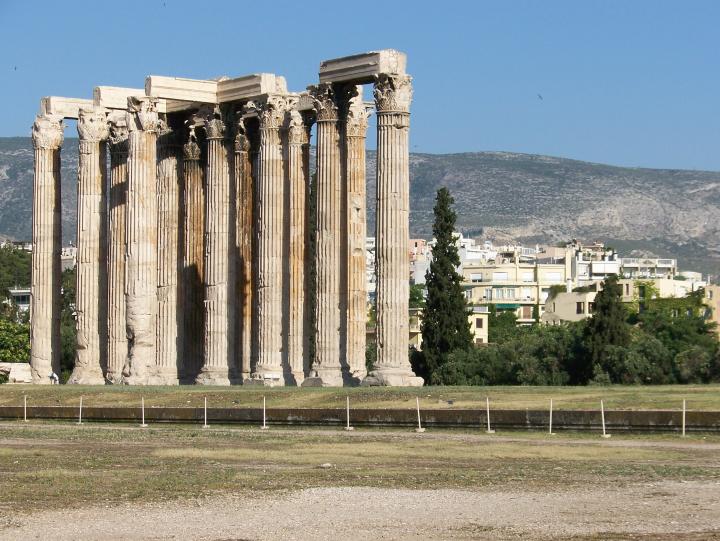
Temple of Olympian Zeus in Athens, Greece (June 2007)
The Temple of Olympian Zeus in Athens, also known as the Olympieion, was the largest temple in ancient Greece, dedicated to the king of the Olympian gods. Construction began in the 6th century BC but was only completed centuries later in the 2nd century AD under the Roman Emperor Hadrian. By June 2007, the temple was a well-preserved ruin, with only 15 of the original 104 columns still standing. Hadrian's Arch, a monumental gateway, stands nearby, marking the boundary between the old and new cities.
Key Features of the Temple of Olympian Zeus:
Size: It was larger than the Parthenon, demonstrating the ambition of the project.
Columns: The original design called for 104 Corinthian columns, but only 15 remain today, along with one that fell in 1852 and is still visible on the site.
Material: The temple was built using expensive Pentelic marble.
Architectural Style: It was the first major temple to use the Corinthian order on its exterior.
Hadrian's Arch: A large arch built by Hadrian to commemorate his contributions to the city, it physically separated the old and new sections of Athens.
Location: It is centrally located in Athens, close to other major landmarks like the Acropolis, Hadrian's Arch, and Syntagma Square.