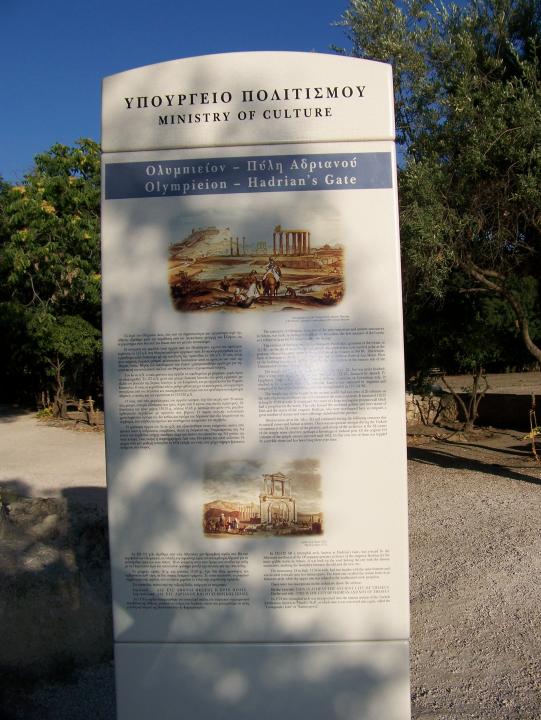
Hadrian's Gate @ Hadrian's Library in Athens, Greece (June 2007)
Hadrian's Library in Athens features a grand entrance known as the Stoa of Hadrian, characterized by Corinthian columns made of Karystian marble and topped with Pentelic marble capitals. This entrance, a propylon, was part of the library's western façade and led into a large courtyard. The Stoa of Hadrian was a significant element of the library's overall design and served as an impressive gateway to the complex.
Here's a more detailed look:
Propylon:
The entrance was a propylon, a monumental gateway, marking the transition from the exterior to the library's courtyard.
Columns:
The propylon featured Corinthian columns, likely made from Karystos (Karystian) marble, known for its green hue, and topped with capitals carved from Pentelic marble, a fine-grained white marble from Mount Pentelicus.
Façade:
The western façade of the library, where the entrance was located, was constructed of Pentelic marble and featured a row of columns.
Courtyard:
The entrance led into a large, open-air courtyard, which was a central feature of the library complex.
Other elements:
The library also included a bibliostasion (library room), lecture halls, and spaces for other activities.
The Arch of Hadrian, also known as Hadrian's Gate, is a triumphal arch in Athens, Greece, located near the Temple of Olympian Zeus (Olympieion). It was built in 131-132 AD by the Athenians to honor the Roman Emperor Hadrian. The arch marks the boundary between the old city of Athens and the new, Roman-influenced city that Hadrian helped develop.
Here's a more detailed breakdown:
Purpose:
The arch was erected to celebrate Hadrian's arrival in Athens and his contributions to the city, particularly his architectural and civic projects.
Location:
It stands on an ancient road that connected the old city center (near the Acropolis) to the Temple of Olympian Zeus and the southeastern area of Athens.
Inscriptions:
Two inscriptions on the arch highlight the dual nature of Athens at the time:
One side reads "This is Athens, the ancient city of Theseus," referring to the mythological founder of Athens.
The other side reads "This is the city of Hadrian and not of Theseus," signifying the new Roman city.
Design:
The arch is a two-story structure made of Pentelic marble, featuring Corinthian columns and pilasters.
Significance:
It serves as a physical representation of the transition from ancient Greek Athens to Roman Athens.